Lunes, Agosto 8, 2016

Lesson IV


                                             SYSTEMATIC APPROACH TO TEACHING


The systems approach views the entire educational program as a system of closely interrelated parts. It is an orchestrated learning pattern with all parts harmoniously integrated into the whole: the school, the teacher, the students, the objectives, the media, the materials, and assessment tools and procedures. Such an approach integrates the older, more familiar methods and tools of instruction with the new ones such as the computer. 


Objectives:
  To know what is systematic approach to teaching
  To enumerate the elements of systematic approach in teaching
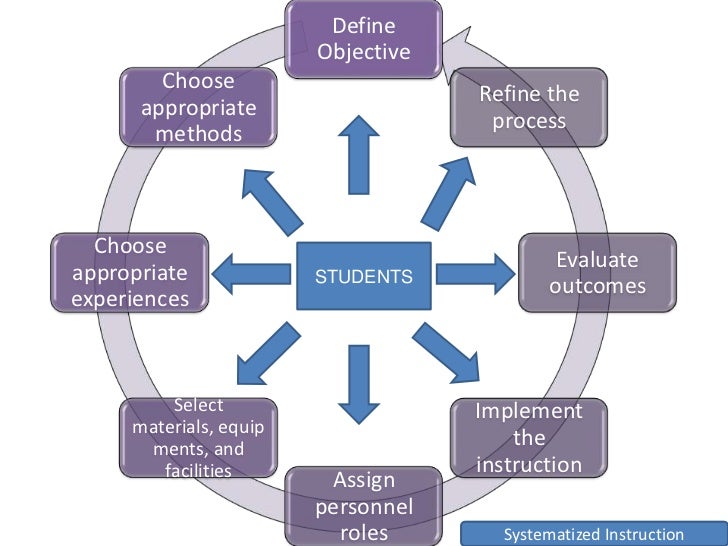


     As depicted in the chart, the focus of systematic instructional planning is the learner. Instruction begins with the definition of instructional objectives that consider the learners’ needs, interests and readiness. On the basis of this objectives, the teacher selects the appropriate teaching – methods to be used and , in turn, based on the teaching method selected, chooses also the appropriate learning experiences and appropriate materials, equipment and facilities.

     The use of learning materials, equipments and facilities necessities assigning the appropriate personnel to assist the teacher and defining the role of any personnel involved in the preparation, setting and returning of these learning resources. ( in some school settings, there is a custodian/librarian who take care of the learning resources  and technician who operate the equipment while teacher facilitates). The effective use of learning resources  is dependent on the expertise  of the teacher, the motivation level or responsiveness, and the involvement of the learners in the learning process. With the  instructional objective in mind, the teacher  implements planned instruction with the use of the selected teaching method, learning activities and learning materials with  the help of other personnel whose role has been defined by the teacher.

     Will the  teacher use direct instruction or indirect instruction? Will he/she  teach the deductive or the inductive method? It depends on his/her instructional objective, nature of the subject matter, readiness of students and the facilitating skills of the teacher himself or herself.

     Examples  of learning activities that the teacher can choose from, depending on his/her  instructional objective, nature of the lesson content, readiness of the students, are reading, writing, interviewing, reporting or doing presentation, discussing, thinking, reflecting, dramatizing, visualizing, creating, judging and evaluating,

     Some examples of learning resources for instructional  use are textbooks, workbooks, programmed materials, computer, television programs, video clips, flat pictures, slides and transparencies, maps, charts, cartoons, posters, models, mock – ups, flannel board materials, chalkboard, real objects and the like.

     After instruction, teacher evaluates the outcome of instruction,. From the evaluation results, teacher comes to know if the instructional objective was attained. If the instructional objective was attained, teacher proceeds to the next lesson going through the same cycle once more. If instructional objective was not attained, then the teacher diagnoses what was not learned and finds out why it was not learned in order to introduce a remedial measure for improved student performance and attainment of instructional objective. This way no learners will be left behind.

Lesson III


                             ROLES OF EDUCATIONAL TECHNOLOGY IN LEARNING


Objective:
      To identify the roles of educational technology in learning.


     For the traditional point of view, technology serves as a source and presenter of knowledge. It is assumed that “knowledge is embedded in the technology (e.g the content presented by films and tv programs or the teaching sequence in programmed instruction) and the technology presents that knowledge to the student (David H. Jonassen, et al,1999).
     Technology like computers is seen as a productivity tool. The popularity of  word processing, databases, spreadsheets, grapic programs and desktop publishing in the 1980’s points to this productive role of educational technology.
     With the eruption of the INTERNET in the mid 90’s, communications and multimedia have dominated the role of technology in the classroom for the past few years.
     From the constructivists point of view, educational technology serves as learning tools that learners learn with it. It engages learners in “active, constructive, intentional, authentic and cooperative learning. It provides opportunities for technology and learner interaction for meaningful learning. In this case, technology will not be mere delivery vehicle for content. Rather it is used as facilitator of thinking and knowledge construction.


     From a constructivist perspective, the following are roles of technology in learning: (Jonassen, et al 1999).
·         Technology as tools to knowledge construction:
o   For representing learners’ ideas, understanding and beliefs
o   For producing organized, multimedia knowledge bases by learners
·         Technology as information vehicle for exploring knowledge to support learning – by – constructing:
o   For accessing needed information
o   For comparing perspectives, beliefs and world views
·         Technology as context to support learning – by – doing:
o   For representing and stimulating meaningful real – world problems, situation and context
o   For representing beliefs, perspectives, arguments and stories of others
o   For defining a safe, controllable problem space for student thinking
·         Technology as a social medium to support learning by conversing:
o   For collaborating with others
o   For discussing, arguing, and building consensus among members of a community
o   For supporting discourse among knowledge – building communities
·         Technology as an intellectual partner (Jonassen 1996) to support learning – by – reflecting:
o   For helping learners to articulate and represent what they know
o   For reflecting on what they have learned and how they came to know it
o   For supporting learners internal negotiations and meaning making
o   For constructing personal representations of meaning
o   For supporting mindful thinking

Whether used from the traditional or constructivist point of view, when used effectively, research indicates that technology  not only “increases students” learning, understanding and achievement but also augments motivation to learn encourages collaborative learning and supports  the development of critical  thinking and problem – solving skills” (Shracter and Fagnano, 1999). Russel and Sorge (1999) also claims that the proper implementation of technology in the classroom gives students more “control of their own learning and.. tends to move classroom from teacher – dominated environments to ones that are more learner – centered. The use of technology in the classroom enables the teacher to do differentiated instruction considering the divergence of students‘ readiness level , interests, multiple intelligences, and learning styles. Technology also helps students  become lifelong learners.

Lesson II

                                           TECHNOLOGY BOON OR BANE


Objective:
 To interpret technology as boon or bane.


     Technology is a blessing for man. With technology, there is a lot that we can do which we could not  do then.  With cell phones, webcam, you will be closer to someone miles and miles away.  So far yet so close! That is your feeling when you talk through a cell phone to a beloved one who is far away from home. Just think of the many human lives saved because of the speedy  notifications via cell phones. Just think of how your  teaching  and learning have become more novel, stimulating, exciting and engaging with the use of multimedia in the classroom. With your tv, you can watch events as they happen all over the globe.

     However, when not used properly, technology becomes a detriment to learning and development. It can destroy relationships.  Think of the husband who is glued to tv unmindful of his wife seeking his attention. This may eventually erode marital relationship. Think of the student  who surfs the internet for pornographic scenes. He will have trouble  with his development. The abuse and misuse of the internet will have far reaching unfavorable effects on his moral life. The teacher who schedules class  tv viewing for the whole hour to free herself from a one – hour teaching and so can engage in “tsismis” , likewise will not benefit  from technology. Neither will her class truly benefit from the whole period of tv viewing.

In education, technology is bane when:
·         The  learner is made to accept as Gospel truth information they get from the internet
·         The learner surfs the Internet for pornography
·         The learner has  an uncritical mind on the images floating on televisions and computers that represent modernity and  progress
·         The tv makes the learner a mere spectator not an active participant in the drama of life
·         The learner gets glued to his computer for computer assisted instruction unmindful of the world and so fails to develop the ability to relate to others
·         We make use of the internet to do character assassination of people whom we hardly like
·         Because of our cell phone, we spend most of our time in the classroom or in our workplace texting
·         We use overuse and abuse tv or film viewing as a strategy to kill time.

Let’s go back  to the question asked  at the beginning of this lesson. Is technology boon or bane to education? It depends on how we use technology. If we use it to help our students and teachers become caring, relating, thinking, reflecting,  and analyzing and feelings beings, then it is boon, a blessing. But if we abuse and misuse it and so contribute to ruin  and downfall and those of other persons, it becomes a bane or a curse.

Lesson I


 Meaning of Educational Technology


To understand the meaning of educational  technology, it may be good to begin with the meaning of technology. The word "technology" comes from the Greek word techne which means craft or art. Based on the etymology of the word "technology", the term educational technology, therefore, refers to art or craft of responding to our educational need.

                                                                                                                                                                   
Image result for educational technology in schools
Many people think that technology  refers only to machines such as computers, tv videos, and the like. All these from part of technology but educational technology is all these and more! Technology is not just machines. It is a "planned, systematic method of working to achieve planned outcomes - a process  not a product. Technology is the applied side of scientific development."(Dale, 1969) Tecnology also refers to any valid and reliable process or procedure that is derived from basic research using the sientific method,"(http://en.wikipedia.org?wiki/Educationaltechnology#Perspectives_and_meaning) Technology refers to "to the ways  people use their inventions and discoveries to satisfy their needs and desires" (The World Book Encyclopedia, Vol 19).  So, educational technology refers to how people use their inventions and discoveries to satisfy their educational needs and desires, i.e learning.

                            Educational technology is "a complex, integrated process involving people, procedure, idea, devices and organization for analyzing problems and devising, implementing, evaluating, and managing solutions to those problem,, involved in all aspects of human learning." Association for Educational Communications and Technology, 1977, The definition of educational technology: A summary, In the definition of educational technology, 1-16, Washington D.C.:AECT).

         Educational technology "consists of the designs and environments that engage learners ... and reliable technique or method for engaging learning such as cognitive learning strategies and critical thinking skills." ( David H. Jonassen, et al 1999).

        Educational technology is a theory about how problems in human learning are identified and solved. (David H. Jonassen, Kyle L. Peck, Brent G. Wilson, 1999). As a theory, educational technology has an " integrated set of principles that explain and predict observed events."

          Educational technology is a field involved in applying a complex, integrated process to analyze and solve problems in human learning  (David H. Jonassen, et al 1999).

          Education technology is a field study which is concerned with the practice of using educational methods and resources for the ultimate goal of facilitating the learning process (Lucido and Borabo, 1997). As a field, it operates within total field of education.

       Educational technology is a profession like teaching. It is made up of organized effort to implement the theory, intellectual techniques, and practical application of educational technology (David h. jonassen, et al 1999).

           From the definitions of educational technology given above, we can say that the educational technology is a very broad term. It is the application of scientific findings in our method, or procedure of working in the field of education in order to effect learning. It embraces curriculum and instructional design, learning environment, theories of teaching-learning. It is also a field study and a profession. It is the use of all human inventions for teachers to realize  their mission to teach in order that students learn. 

Technology in education is “ the application of technology to any of those processes involved in operating the institutions which house the educational enterprise. It includes the application of technology to food. Health, finance, scheduling, grade, reporting, and other processes which support education within institutions”. (David H. Jonassen, et, al 1999).

 Instructional technology is a part of educational technology. Technology integration means using “learning technologies to introduce, reinforce, supplements and extend skills.” (Williams, ed.2000).

Educational media are channels or avenue or instruments of communication. Examples are books, magazines, newspapers, radio, television and internet. These media also serve educational purposes.